Research notes for people who do the work
Data studies, methodology, and the craft of covering more names, faster. Peer-analyst, no hype.
 Featured · Reading filings
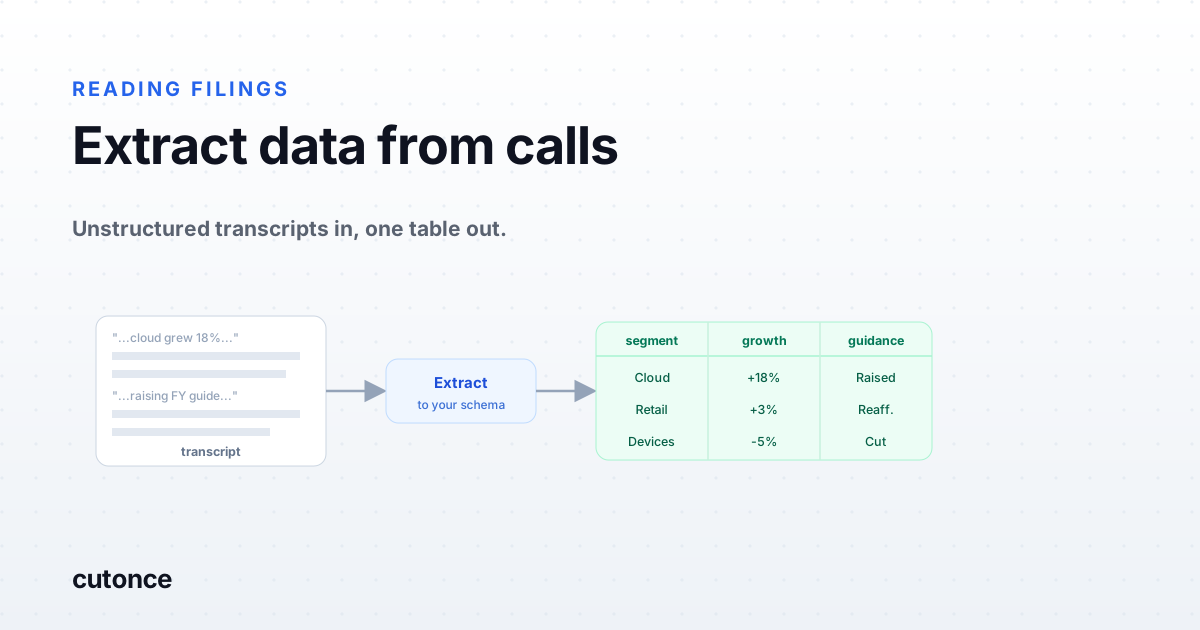
Extracting structured data from earnings calls: the pipeline and the table it returns
The number you want - a raised guidance figure, a segment growth rate, a KPI management mentioned once - is buried in forty pages of transcript, in a different place in every call. For one company that is reading. For a hundred it is a data-extraction problem. Here is the pipeline, and the table it returns.
Read the postThe REIT dividend-safety screen I run on AFFO payout, not EPS payout
A REIT's EPS payout ratio routinely reads above 100% and means almost nothing, because depreciation swamps the number. The denominator that matters is AFFO. Here is the actual pipeline I run to screen REITs on AFFO payout - node by node, with the output.
Read Research at scaleThe earnings-transcript AI screener I run overnight, and the output it hands me
Transcripts drop after the close and there are too many to read by morning. Here is the actual pipeline I run overnight to turn a few hundred calls into a short list - every node, every filter, and the shape of the output.
Read Reading filingsSEC filing automation for analysts: the morning pipeline behind my insider-buying + earnings-beat screen
EDGAR does not sleep, and Form 4s and 8-Ks pile up overnight. Here is the actual pipeline I run to surface names where an insider bought on the open market and the company just beat - node by node, with the output it produces.
Read Reading filingsScreening earnings calls and filings for supply-chain risk
Supply-chain stress shows up in the language before the numbers - shortages, lead times, single-source suppliers, input costs. How to screen transcripts and filings for it across a universe, and catch it escalating.
Read The analyst's craftSeparating real AI efficiency from AI hype in earnings calls
Every company now name-drops AI. The screen worth running separates a concrete, quantified efficiency claim from a buzzword for the multiple - and checks it against the margins and headcount.
Read Research at scaleHow to analyze every bank's earnings call in a quarter
Banks all report on the same few things - NIM, deposits, credit quality, capital. That makes the whole industry perfect for reading at scale: one fixed extraction across every call, turned into a sortable table. The workflow, with banking as the worked example.
Read ScreeningScreening for undervalued small caps and deep-value contrarians
Small caps and beaten-down deep-value names are where inefficiency still lives - because almost no one reads them. How to screen for real undervaluation and tell cheap-for-a-reason from cheap-and-wrong.
Read ScreeningHow to screen for quality compounders and financial strength
A quality compounder earns high returns on capital and can reinvest at them for years. How to screen for that durability - and the cash-rich, low-debt balance sheet that tells a real compounder from a fragile one.
Read The analyst's craftReading management quality at scale: evasion, hedging, and confident guidance
Reading a management team is a judgment call - until you make it repeatable. How to score evasion, guidance confidence, and the prepared-vs-Q&A gap across every call in your universe, the same way each quarter.
Read ScreeningBacktesting a dividend-safety screen against real dividend cuts
A dividend-safety screen claims to flag at-risk payouts. Prove it against ground truth: take companies that actually cut, rebuild their pre-cut numbers, and measure the hit rate. The method - and why some cuts can never be caught.
Read The analyst's craftAutomating a DCF valuation across hundreds of tickers
A DCF for one name is easy; for a universe it is a different problem. The point is not precision - it is running the same model across every name so you can rank by margin of safety. How to automate it, and where it breaks.
Read The analyst's craftIs OpenBB or Perplexity Finance enough for professional equity research?
OpenBB is a programmable data layer for coders. Perplexity Finance is a fast answer engine for one-off questions. Both are good at what they do - neither is built to run a defined screen across a universe on a schedule.
Read ScreeningScreening 13F filings for what institutions actually bought
One 13F is a stale, longs-only snapshot. The signal is the change quarter over quarter, and where it clusters across funds. How to diff 13Fs at scale without being misled by the filing's built-in blind spots.
Read Reading filingsMonitoring 8-K filings for guidance changes and material events at scale
The 8-K is the market's real-time disclosure stream - results, guidance, executive exits, auditor changes. It arrives unpredictably, which is why it is hard to watch by hand. How to monitor and triage it at scale.
Read Reading filingsCross-checking earnings-call claims against the 10-K and 10-Q
What management says on the call and what the company writes in the filing do not always match. The gap is a checkable signal. How to diff spoken claims against the filing across a whole universe.
Read The analyst's craftCan AI replace a Bloomberg terminal for equity research?
A terminal sells data, speed, a messaging network, and execution. AI replaces one of those well and none of the rest. The honest test for whether you can drop the seat - and what you still cannot.
Read The analyst's craftHow to analyze earnings call transcripts at scale
Reading one call is easy. Reading all of them the same way, every quarter, is the job. The four steps that turn transcript reading into a repeatable process - and the failure modes that make ad-hoc attempts useless.
Read ScreenersThe best AI stock screeners in 2026 (and what "AI" actually means)
"AI stock screener" is doing a lot of work in 2026 marketing. Almost all of them score stocks from structured numbers. Very few read the actual filings or transcripts. Here is how to tell them apart.
Read ScreenersThe 5 best stock screeners in 2026 (and where each one wins)
There is no single best screener - only the best one for a job. A fair look at the five that lead in 2026, what each is genuinely good at, and the one thing none of them do.
Read Reading filingsHow to compare 10-K risk factors year over year
A risk factor is only interesting against last year's. How to diff Item 1A year over year to find the new, removed, and quietly reworded risks - and separate real signal from boilerplate churn.
Read ScreeningCluster insider buying: the signal single-buy screeners miss
A lone insider purchase tells you little. A cluster - multiple insiders buying on the open market in a short window - is a different and more durable signal. What counts as a real cluster, and how to find them at scale.
Read ScreeningWhy your backtested screen beats the market but loses live
The gap between a great backtest and a disappointing live result is usually three culprits: look-ahead bias, survivorship bias, and overfitting. How each one inflates your backtest, and how to build a screen that survives contact with the market.
Read The analyst's craftWhich AI is best for equity research?
The honest answer is 'it depends on the job.' A comparison of the frontier assistants for reading filings and earnings calls - and the point where a chat window stops being the right tool.
Read Reading filingsHow to screen a 10-K for red flags
Red flags in a 10-K are rarely in the headline numbers. A section-by-section checklist for what to actually read, and how to turn it into a repeatable screen across every name you cover.
Read ReferenceForm 4 transaction codes, explained
The full list of Form 4 transaction codes, in plain language - plus the part that actually matters: which codes are a real open-market buy and which are grants, tax withholding, or gifts dressed up as activity.
Read The analyst's craftFinBERT vs Loughran-McDonald vs LLMs: which financial sentiment engine should you use?
The three ways to score sentiment on filings and earnings calls, compared on the axes that actually matter to an analyst: context handling, transparency, cost, and scale.
ReadPut the ideas to work
Turn a research thesis into a repeatable pipeline. Free to start.