Reading management quality at scale: evasion, hedging, and confident guidance
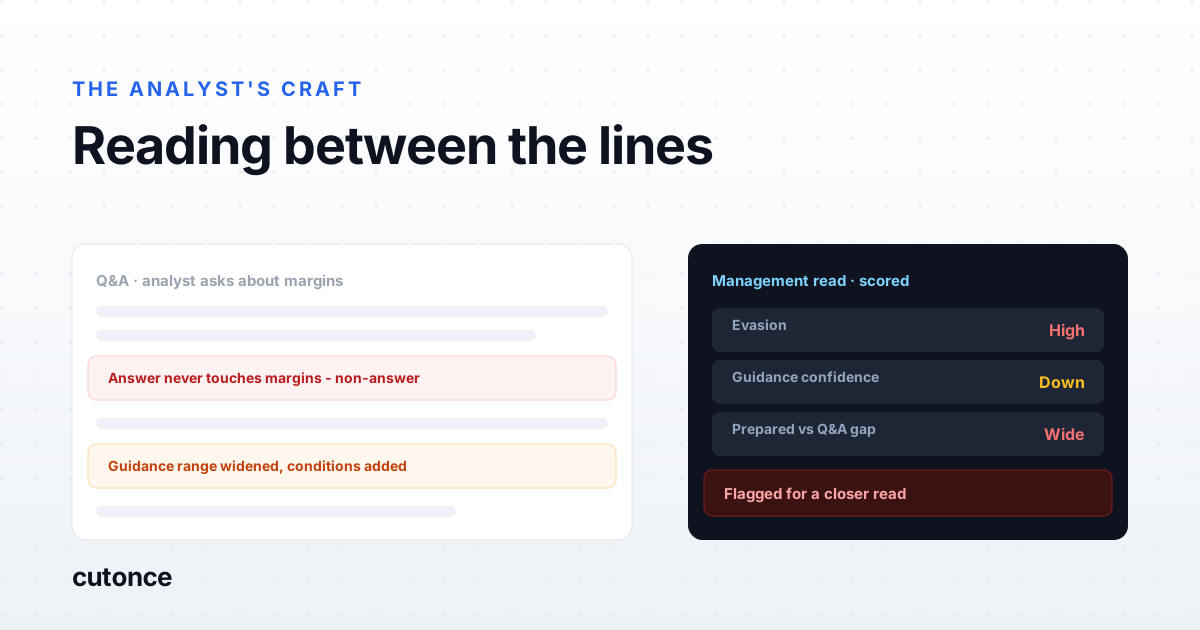
- A management-quality read is really three separate reads: whether questions get answered (evasion), how firmly the future is committed to (guidance confidence), and whether the confident story survives contact with analyst questions (the prepared-vs-Q&A gap).
- Evasion shows up structurally, not just in tone: questions asked and not answered, topics deflected to 'we'll follow up', and answers that restate the question without new information. Those are countable.
- Confident guidance and hedged guidance use different language. 'We expect' and a specific number reads differently from 'we're comfortable with the range subject to macro conditions' - and the shift quarter over quarter is the signal.
- The read only becomes useful at scale when it is consistent: the same questions asked of every call, so the scores are comparable and you can rank management teams instead of forming an impression one call at a time.
"Management quality" is the kind of judgment good analysts trust themselves to make and struggle to defend on paper. You listen to a call and you come away with a feeling: this team is straight, that one is spinning. The problem is not that the read is wrong - it is that it does not scale and it is not comparable. You cannot form a careful impression of two hundred management teams in a reporting season, and two impressions formed a month apart are not measured against the same yardstick. The way to fix that is to break the read into a few observable behaviors and score them the same way on every call. Here is how.
A management read is three reads
Lumped together, "quality" is too vague to score. Split apart, it is three concrete questions you can ask of any transcript:
- Evasion: do analyst questions actually get answered, or deflected, restated, and pushed to a follow-up?
- Guidance confidence: is the outlook committed to with a specific number, or widened and qualified into near-meaninglessness?
- The prepared-vs-Q&A gap: does the confident story in the scripted section hold up once analysts choose the topics?
Each of these is observable in the text, which means each can be scored consistently rather than felt. And the three together are far more informative than any one alone.
Evasion is structural, not just a tone
The instinct is to treat evasion as a vibe - the CEO sounded slippery. But the useful signal is structural and countable. A question was asked about the margin outlook and the answer talked about long-term strategy without touching margins: that is a non-answer, and you can flag it. An analyst pressed on the same cost line three times: that is a topic management did not want to sit on. A commitment from last quarter got a vaguer qualifier this quarter, or disappeared: that is a walk-back. None of that requires reading the CEO's soul; it requires checking whether questions were answered, and it is the same check on every call.
This is why splitting prepared remarks from Q&A matters so much. Prepared remarks are written and rehearsed; Q&A is live and adversarial. The mechanics of doing that split across a universe are in analyzing earnings call transcripts at scale, and it is the foundation the whole management read sits on.
Confident guidance versus hedged guidance
Guidance language falls into registers, and the register carries information the number alone does not. "We expect revenue of $4.2 billion" is a commitment. "We're comfortable with the range we gave, subject to the macro environment" is a hedge dressed as reassurance. Neither is inherently good - a hedge can be honest and a commitment can be reckless - but the register a team uses, and whether it shifted from last quarter, is a real read on how solid the outlook is.
The move that pays off is the diff: a team that gave a crisp number last quarter and this quarter widened the range and added conditions is telling you something, even if the midpoint did not move. Scoring guidance confidence as its own field, quarter over quarter, catches that. On whether to score this language with a lexicon or a model, the tradeoffs are in FinBERT vs Loughran-McDonald vs LLMs.
Score it consistently, or it is just an impression
The entire value of this is comparability. If you ask each call a slightly different question, you get answers you cannot rank - a pile of impressions, not a dataset. Define the fields before the run and apply them identically:
| Field | What you are scoring |
|---|---|
| Evasion score | Count of unanswered or deflected questions, relative to questions asked. |
| Guidance register | Committed / qualified / withdrawn - and the change from last quarter. |
| Prepared-vs-Q&A gap | How far the Q&A tone falls below the scripted tone. |
| Carryover language | Whether a prior commitment got firmer, vaguer, or vanished. |
| Source quote | The exact exchange behind each flag, so you can verify in seconds. |
The last row is the guardrail. A management-quality flag with no quote attached is an accusation you cannot check; with the quote, it is a five-second read.
Cross-check the words against the filings
The strongest version of this read does not stop at the call. What a management team says out loud and what the company writes in the 10-Q under a liability standard do not always agree, and the gap is its own signal. Running the call read alongside the filing is covered in cross-checking earnings-call claims against filings, and a confident verbal claim that the filing quietly hedges is exactly the kind of thing a management read should surface.
Running it as a pipeline
In Cutonce this is a saved pipeline: a transcript node pulls every call in the universe, an AI node runs the same evasion, guidance, and gap reads against each one, and the output is a ranked table you can send to a sheet or Slack - each management team scored, with the exact exchanges attached. Because it is saved, next quarter is a rerun, and the scores line up against the last one so you can watch a team drift toward evasion or firm up over time.
The judgment stays yours. What changes is that you stop deciding which ten calls to listen to and start with the teams the run flagged - the ones that stopped answering, hedged the number, or said one thing on the call and another in the filing.
Note: this is not investment advice. Scoring management behavior produces a shortlist of teams worth a closer read, not a verdict on honesty, and models misread tone and context. Keep the source exchange next to every flag and verify anything you act on against the actual transcript and filings.
Frequently asked
Can you assess management quality from an earnings call? You can assess specific, observable behaviors that correlate with it: whether analyst questions actually get answered, how firmly guidance is committed to, whether the tone of prepared remarks holds up under live questioning, and whether the language around a prior commitment got vaguer. None of these is a full character read, but scored consistently across a universe they surface the teams worth a closer look and the ones worth skepticism.
How do you detect CEO evasion on a call? Evasion is more structural than tonal. Look for questions that were asked but never answered, answers that restate the question without adding information, topics repeatedly deflected to a follow-up, and a widening gap between how upbeat the prepared remarks were and how hedged the Q&A became. Those patterns are countable, which means they can be scored the same way across every call rather than felt one at a time.
What is the difference between confident and hedged guidance? Confident guidance commits: a specific number or a narrow range stated plainly, with few qualifiers. Hedged guidance widens the range, leans on conditions ('subject to macro', 'assuming stability'), or withdraws specificity entirely. Neither is inherently good or bad, but tracking which register a team uses - and whether it changed from last quarter - tells you how solid the outlook really is.
Can this be done across a whole watchlist automatically? Yes, and that is where it earns its keep. A pipeline pulls every transcript, runs the same fixed reads (evasion, guidance confidence, prepared-vs-Q&A gap) over each one, and returns a ranked, sourced table. Reading one management team by hand is easy; reading all of them the same way every quarter is the job a pipeline does.