Cross-checking earnings-call claims against the 10-K and 10-Q
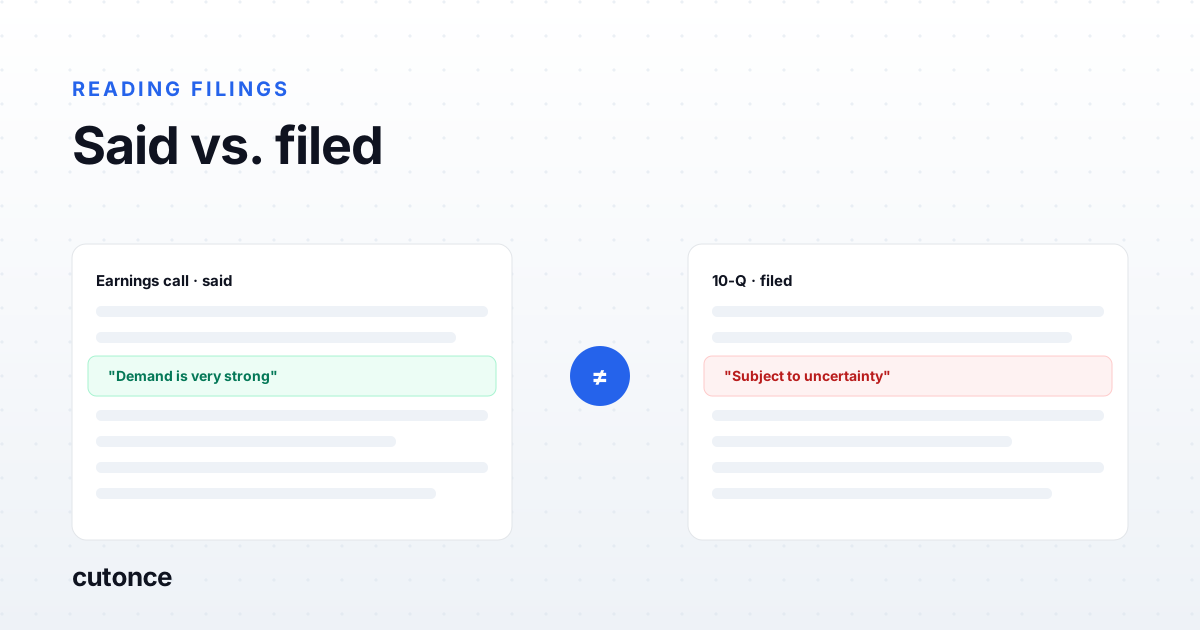
- The call and the filing are written for different audiences under different liability. The call persuades; the filing discloses. When they diverge on the same fact, the divergence itself is the signal.
- Three gaps are worth catching: an omission (said on the call, absent from the filing), a softening (upbeat spoken, hedged in print), and a contradiction (the two make claims that cannot both be fully true).
- The workflow pairs each call to the matching filing, extracts the same claims from both, matches them by topic, and flags where the paired statements diverge - keeping the source quote from each side so the flag is verifiable in seconds.
- Done by hand this is only feasible for a handful of names. As a pipeline it runs across the whole universe every reporting cycle, which is the only way the rare real divergence surfaces at all.
Management says one thing on the earnings call and writes another in the 10-Q, and usually the difference is nothing. But not always, and the times it is not nothing are worth finding. The call and the filing are two accounts of the same quarter produced days apart for entirely different purposes. When they diverge on the same fact, you have something specific and checkable: not a feeling that the tone was off, but a spoken claim and a written disclosure that do not line up, each with a quote you can point to.
Why the call and the filing disagree
The two documents are built under different pressure. The earnings call is a live, persuasive event. Prepared remarks are reviewed, but the framing is management's to choose, and the job of the call is to set the narrative for the quarter. The 10-Q and 10-K are formal disclosures. The language is precise and heavily qualified because it carries direct legal liability, and the people who write it are optimizing to be complete and defensible, not upbeat.
So the same fact can be true in both places and still look different: a confident sentence on the call becomes a hedged paragraph in the filing. That is not deception, it is the two audiences. The point of comparing them is not to catch anyone lying. It is that the distance between the confident version and the careful version is a read on how solid the confident version really is.
The three gaps worth catching
Not every difference is interesting. Three shapes are:
| Gap | What it looks like | Why it matters |
|---|---|---|
| Omission | Emphasized on the call, absent or much weaker in the filing. | The narrative leans on something the disclosure will not fully stand behind. |
| Softening | Upbeat spoken claim, qualified or hedged in print. | The most common and often the most telling - it shows where the confidence thins under a liability standard. |
| Contradiction | A spoken claim and a written disclosure that cannot both be fully true. | Rarest and highest value. Almost always worth a manual read before you do anything with it. |
Softenings are the workhorse. A management team that calls demand "very strong" on the call and describes it as "subject to continued macroeconomic uncertainty" in the risk factors is not contradicting itself, but the gap between those two registers, tracked across a coverage universe, sorts the confident-and-backed from the confident-and-hopeful.
The workflow
The comparison only works if both sides are extracted the same way. The steps:
- Pair the sources.Match each earnings call to the 10-Q or 10-K covering the same fiscal period. Getting the period label right matters here as much as anywhere - a call paired to the wrong quarter's filing produces noise that looks like signal.
- Extract claims from each side in the same shape. Pull a fixed set of topics from both the transcript and the filing: demand, pricing, margin, guidance, and anything flagged as a risk. Same fields, same question, both documents.
- Match by topic. Line the spoken claim about margin up against the written statement about margin, so you are comparing like with like rather than scanning two full documents.
- Flag divergence, keep both quotes. Where the paired statements disagree, record the flag with the exact sentence from the transcript and the exact sentence from the filing. The quotes are what make it a five-second check instead of a re-read.
The written-side technique overlaps with straight filing analysis. If you are also tracking how the filing language itself moves over time, that pairs naturally with comparing 10-K risk factors year over year, and the two together - what changed in the filing, and where the call departs from it - are stronger than either alone.
Doing it across a universe
By hand, this is a two-name exercise. You can hold one call and one filing in your head and feel the gap. You cannot do it for two hundred names in a reporting cycle, which is exactly the scale at which the rare real divergence is worth finding, because you do not know in advance which two names they will be. The only way the signal surfaces is to run the comparison over everything and let the flags concentrate your attention.
The output should be a short list: the names where the spoken and written accounts diverged, ranked by how far and on what topic, each with both quotes attached. That is a morning's worth of genuine reading pulled out of a universe you could never have read in full.
What breaks
- Period mismatches. Pairing a call with a filing from a different period manufactures divergences that are just calendar errors.
- Topic mismatches. Matching a spoken claim about one segment to a written statement about another produces false flags. The match has to be topic-aware, not keyword-loose.
- Ungrounded flags. A divergence flag with no quote on either side is unverifiable and worse than nothing, because it invites action without a check.
- Treating benign gaps as signal. Most divergences are innocent. The output is a place to look, and reading it as a verdict is how this technique gets people into trouble.
Running it as a pipeline
In Cutonce this is a saved pipeline: a transcript node pulls the calls for your universe, a filings node pulls the matching 10-Qs and 10-Ks from EDGAR, an AI node runs the same claim extraction over both and flags where the paired statements diverge, and the result lands as a table you can filter and send to a sheet or a Slack channel. Because it is saved rather than done once, next reporting cycle is a rerun, and every flag arrives with the transcript quote and the filing quote side by side.
The analyst work does not go away; it lands where it should. Instead of reading two hundred calls and two hundred filings to find the three that do not agree, you read the three, with both quotes already pulled.
Note: this is not investment advice. A gap between a call and a filing is a prompt to read, not a conclusion, and models do misread both transcripts and filings. Keep the source quotes attached and verify any divergence against the company's own transcript and filing before acting on it.
Frequently asked
Why would an earnings call and the 10-K disagree? Because they are produced for different purposes under different legal exposure. The earnings call is a live, persuasive communication where management frames the quarter; prepared remarks are reviewed but the tone is chosen. The 10-K and 10-Q are formal disclosures where the language is precise, qualified, and lawyered because it carries direct liability. The same fact can be presented confidently on the call and hedged in the filing, and that difference is meaningful rather than accidental.
What kinds of gaps between the call and the filing matter? Three. An omission: something management emphasized on the call that does not appear, or appears far weaker, in the filing. A softening: an upbeat spoken claim that becomes a qualified or hedged statement in print. And a contradiction: a spoken claim and a written disclosure that cannot both be fully true. Contradictions are rarest and most valuable; softenings are the most common and often the most informative about management's real confidence.
How do you compare call claims to filings at scale? Pair each earnings call to the 10-Q or 10-K covering the same period, extract a fixed set of claims from each source in the same shape, match the claims by topic, and compare the paired statements. Flag divergence and keep the exact quote from both the transcript and the filing next to each flag. Uniform extraction is what makes the comparison possible across many names rather than one at a time.
Is a gap between the call and the filing a sell signal? No. It is a place to look, not a conclusion. Most divergences have benign explanations - timing, a topic that belongs in one document and not the other, or ordinary caution in disclosure language. The value of catching the gap at scale is that it narrows a universe to the handful of names where the spoken and written accounts do not line up, so your attention goes where there is something to check.