Can AI replace a Bloomberg terminal for equity research?
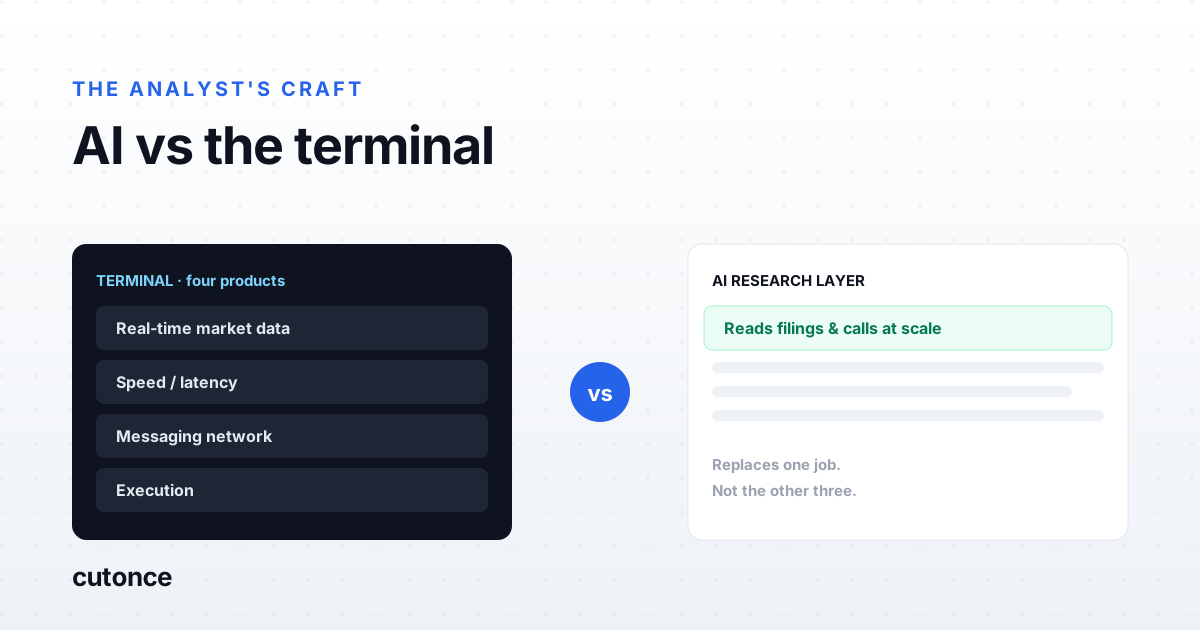
- A terminal is four products in one: real-time market data, sub-second speed, the messaging network, and execution. AI substitutes for the research and reading layer sitting on top of the data, not for the data feed, the network, or the wire.
- The job AI genuinely replaces is reading and synthesis at scale: filings, transcripts, and screening across a universe. That is often the majority of a research analyst's terminal time and almost none of a trader's.
- The honest test is whether your seat is a research seat or a trading seat. Research-heavy seats are the ones where a cheaper data feed plus an AI research layer covers most of what you actually open the terminal for.
- For a boutique RIA, the decision is rarely all-or-nothing. Keeping one terminal for market data and comms while moving the reading and screening work to a research pipeline is usually the defensible middle.
The question comes up every renewal cycle now, and it is usually asked the wrong way. "Can AI replace a Bloomberg terminal" treats the terminal as one thing. It is not. A terminal is four products sold as one: real-time market data, the speed to act on it, a messaging network that the buy side and sell side actually run on, and execution. AI replaces exactly one of those well, adjacent to a fifth thing the terminal throws in - the research and reading layer on top of the data. Whether you can drop the seat depends entirely on which of the four you are really paying for.
What a terminal actually sells you
Strip the branding and a terminal is four moats stacked together. First, consolidated market data: real-time, exchange-quality pricing across equities, fixed income, FX, commodities, and derivatives, cleaned and normalized. Second, speed: latency low enough that people trade on it, which is a different engineering problem than displaying a number. Third, the network: the messaging system is where a large part of the street negotiates, confirms, and talks, and a network's value is that everyone else is already on it. Fourth, execution: the ability to route and confirm an order without leaving the screen.
None of those four is a reading problem, and none of them is what an AI tool does. That matters, because the honest version of this question is not "is AI as good as Bloomberg" but "which of these four am I actually using, and is any of them the reason I keep the seat."
What "replace it with AI" usually means
When an analyst says they want AI to replace the terminal, they almost never mean the tick data or the order wire. They mean the part of the day spent reading: opening filings, pulling up the last four earnings calls, running a screen, chasing a fundamental across a peer set, and turning all of it into a view. That work happens to sit on the terminal because the data is there, but it is a research task, not a market-data task. It is the layer where a model genuinely changes the economics, because it is the layer that scales badly by hand.
So the real comparison is narrow and answerable: for reading, screening, and synthesis, can a research tool do what you currently use the terminal for? For that subset, the answer is increasingly yes.
Where AI genuinely substitutes
The reading and synthesis layer is where the substitution is real, and it is real because the alternative is a person doing repetitive work under a time constraint. Three jobs in particular:
- Reading filings at scale. Screening 10-Ks and 10-Qs for specific language, diffing risk factors across years, flagging accounting red flags across a universe - work that is linear in the number of names when done by hand, and near-constant when run as a pipeline.
- Reading calls at scale. Extracting guidance, tone, and analyst pressure from every earnings call in your coverage the same way, every quarter, instead of triaging down to the ten you have time for.
- Screening and synthesis. Running a defined thesis across hundreds of tickers and getting back a ranked, scored shortlist rather than a raw table you still have to read.
For a research analyst, that is not a marginal slice of terminal time. It is often most of it. The terminal was the tool because it had the data, not because it was good at the reading.
Where it does not substitute
Be equally honest about the other side. A research pipeline reads data; it does not source real-time consolidated market data, and it is not built for the latency a trader needs. It does not put you on the messaging network your counterparties expect to reach you on, and it does not execute. If your seat exists for live trading, for fixed income where the terminal's data and liquidity picture is genuinely hard to replicate, or because dropping the network would cut you out of conversations, then AI is not addressing the reason you have the seat. No amount of reading capability replaces a wire.
The test: is it a research seat or a trading seat?
The decision resolves to one question. Track what you actually open the terminal for over a normal week. If the honest answer is filings, transcripts, screening, fundamentals, and building a view - that is a research seat, and most of its value can move to a cheaper data feed plus a research layer. If the answer is watching live markets, trading, fixed income, or staying on the network - that is a trading seat, and it stays.
Most desks have both kinds of seat and price them identically, which is where the waste hides. The research seats are the ones worth re-examining, because they are paying full terminal price for the one capability a terminal is not uniquely good at.
What this means for a boutique RIA
For a small shop the math is concrete. A terminal seat runs into the tens of thousands per year. If two of your four seats are research seats - used mostly for reading and screening - the question is whether a market-data provider for prices and fundamentals, direct access to primary sources like SEC EDGAR and transcript data, and a research pipeline that reads and screens on a schedule covers what those two seats are for. Often it does, and the remaining terminal stays for market data and comms.
That is the defensible answer, and it is not the hype answer. AI does not replace the terminal. It replaces the reason a research-only analyst needed one, which is a narrower and more useful claim.
Where Cutonce fits
This is the layer Cutonce is built for: the reading, screening, and synthesis, not the market-data feed or the wire. You connect primary sources - filings from EDGAR, earnings call transcripts, fundamentals, insider data - chain filter, scoring, and AI nodes to encode your thesis, and run it across your whole universe on a schedule, with results landing in a sheet, Slack, or email. It sits alongside whatever data feed you keep, and takes over the part of the terminal day that was always a reading problem. For the model-choice question underneath all of this, see which AI is best for equity research.
Note: this is not investment advice, and it is not a data-vendor comparison of market-data quality. It is a framing for which part of a terminal seat is a research task. Verify any coverage, latency, or data requirements against your own workflow before changing a subscription you rely on.
Frequently asked
Can AI replace a Bloomberg terminal? For the research and reading layer, largely yes; for the rest of what a terminal does, no. AI tools now read filings and transcripts, screen across a universe, and synthesize findings faster than a person working by hand. What they do not replace is the terminal's real-time consolidated market data, its sub-second latency, the Bloomberg messaging network that the buy and sell side actually communicate on, and order execution. Whether replacement is realistic depends entirely on which of those four you use the seat for.
What can an AI research tool not replace about a terminal? Four things. Real-time, consolidated, exchange-quality market data across every asset class. Latency measured in milliseconds for anyone who trades on it. The messaging network, which is a communications standard on the street rather than a feature you can swap. And execution - routing and confirming orders. A research pipeline sits above the data and reads it; it does not source the tick data or move an order.
Is a Bloomberg terminal worth it for a small RIA? It depends on whether the seat is a trading seat or a research seat. If most of the terminal time is spent reading filings and calls, screening, and pulling fundamentals for analysis, a cheaper market-data feed plus an AI research layer covers the bulk of it at a fraction of the cost. If the seat is used for live trading, fixed income, or because your counterparties reach you on the messaging network, the terminal is doing work that a research tool does not touch.
What is a cheaper research stack than a full terminal? A workable split is a market-data provider for prices and fundamentals, direct access to primary sources (SEC EDGAR for filings, transcript data for calls), and a research pipeline that reads and screens across the universe on a schedule. That covers the reading, screening, and synthesis a terminal is often used for, without paying for the trading and messaging infrastructure a research-only seat never uses.