Which AI is best for equity research?
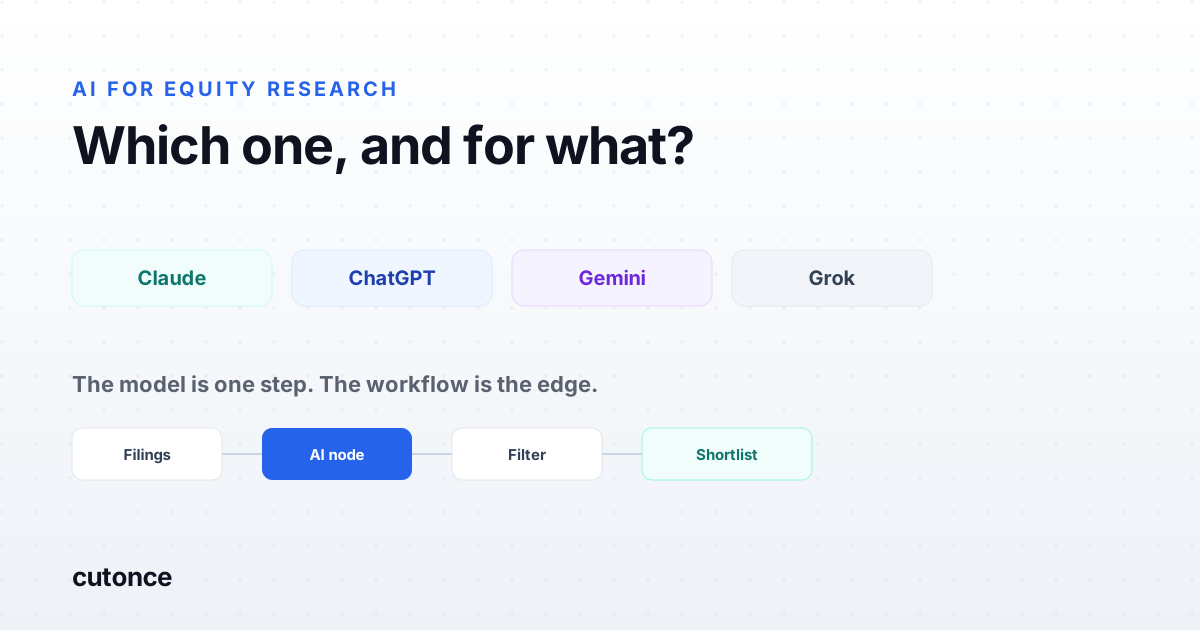
- For a single deep read - one 10-K, one earnings call - the frontier chat assistants are all genuinely useful. Claude and ChatGPT lead on reasoning over filings; Gemini is strong on very long documents; Grok is the weakest for rigorous work but useful for real-time chatter.
- "Best" for research is not the smartest model in the abstract. It is the one that reasons well over primary sources, tells you what it used, and lets you verify. Treat any unsourced number as wrong until you check it.
- The chatbots break down at scale and on repeatability. Reading 500 filings, re-running the same analysis every quarter, and producing an audit trail are not chat problems - they are workflow problems.
- Match the tool to the job: a general assistant for a one-off deep dive, a repeatable pipeline (with the model as one step) for coverage at scale. The workflow around the model matters more than which model you pick.
"Which AI should I use for equity research?" is the wrong question asked well. Everyone wants a single winner, and the honest answer is that the frontier assistants are close enough on raw capability that the model is rarely the thing holding your research back. What holds it back is doing the work across a universe of names, repeatably, with a record you can defend. Let me split the question into the part the models actually decide and the part they do not.
What "best" actually means for equity research
A model that tops a math benchmark is not automatically good at reading a 10-K. For research, four things matter more than headline IQ:
- Reasoning over primary sources - can it hold a full filing or transcript in context and reason about it, not just summarize the first few pages?
- Verifiability - does it tell you which passage or number it used, so you can check it? An unsourced figure is a liability, not an answer.
- Restraint - does it say "the filing does not state this" instead of inventing a plausible number?
- Structure - can it return clean, consistent output (a table, a score, a flag) you can act on rather than prose you have to re-read?
Notice that none of those is "smartest." They are about trust and repeatability, which is exactly where this gets interesting.
The general assistants, compared
As of mid-2026, here is how the frontier chat assistants stack up for the specific job of reading filings and calls. These are practitioner impressions, not benchmark scores - and all of them change with every release, so re-test before you rely on any of it.
| For research | Claude | ChatGPT | Gemini | Grok |
|---|---|---|---|---|
| Long filings / context | Strong | Strong | Strong (longest) | Good |
| Reasoning & rigor | Strong | Strong | Good | Mixed |
| Citations & verifiability | Good | Good | Good | Mixed |
| Fresh market/news data | With tools | Good (web) | Good (web) | Good (real-time) |
| Structured output | Strong | Strong | Good | Mixed |
The short version: for careful work over filings and transcripts, Claude and ChatGPT are the safest defaults, Gemini earns its place when the document is enormous, and Grok is best kept for a real-time read on news and social chatter rather than line-by-line financial analysis. Every one of them will still invent a number if you let it, so the caveat below is not optional.
Where a chat window stops being enough
Here is the part the model choice does not solve. A chat assistant is a great way to read onedocument. Research is rarely about one document. The moment the job becomes "do this across my universe, and again next quarter," four problems show up that no amount of model quality fixes:
- Scale. Pasting 500 filings into a chat one at a time is not a workflow. You need the same prompt applied to every name, automatically.
- Reproducibility. A chat is a one-off. Next quarter you want the exact same logic run again, not a slightly different conversation.
- Audit trail. "The AI said so" does not survive a client review. You need to show the inputs, the criteria, and the output for every name.
- Hallucinated numbers. In a chat you catch a bad figure because you are reading closely. Across 500 names, an unverified number becomes a silent error in your screen.
So which one should you use?
For a deep one-off read - pulling apart a single 10-K, pressure-testing a thesis, drafting questions before a call - use whichever frontier assistant you already trust; Claude or ChatGPT are hard to beat, and the difference between them matters less than your prompting.
For coverage at scale, the question changes from "which model" to "what runs the model." You want the model as one explicit step in a repeatable pipeline: pull the filings, apply the same AI-scoring criteria to every name, filter, and deliver a shortlist you can audit. That is the gap Cutonce is built to close - you keep control of the criteria and the model becomes a node in a workflow you can re-run and defend, instead of a chat you redo by hand. The point is not that AI replaces the analyst; it is that the analyst stops being the bottleneck.
Note: model capabilities move fast and vary by version and prompt. Nothing here is investment advice. Use AI output as one input to a process you control, and verify figures against primary sources before acting on them.
Frequently asked
Is Claude or ChatGPT better for analyzing filings and earnings calls? Both are strong; the honest answer is that your prompt and your verification process matter more than the choice between them. Test both on your own filings before committing.
What is the best AI tool to analyze 10-K and 10-Q filings? For one filing, a frontier chat assistant. For many filings on a schedule, a pipeline that applies a model to each one, so the analysis is consistent, repeatable, and auditable.
Can I trust the numbers an AI pulls from a filing? Not without checking. Treat every figure as a claim to verify against the source, and prefer setups that cite the passage they used.