The 5 best stock screeners in 2026 (and where each one wins)
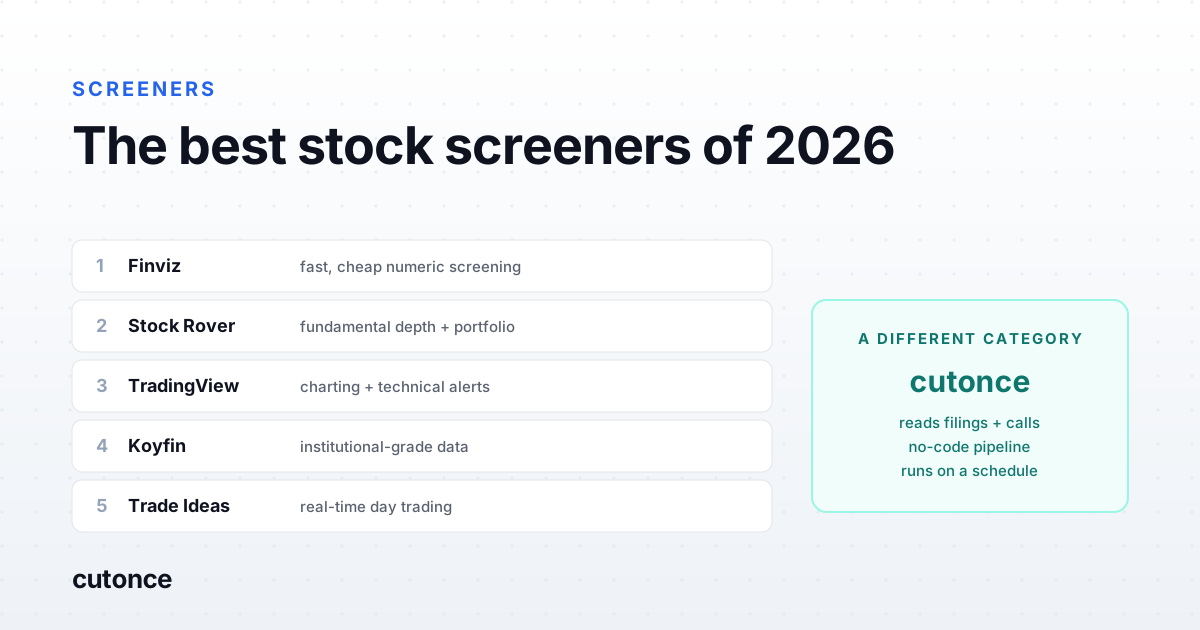
- There is no universally best screener. Finviz wins on fast, cheap numeric screening; Stock Rover on fundamental depth and portfolio tools; TradingView on charting; Koyfin on institutional-grade data; Trade Ideas on real-time day trading.
- Pricing spans free to a few hundred dollars a month. Verified 2026 figures: Finviz Elite $39.50/mo, Stock Rover $29-$149/mo, TradingView $12.95-$199.95/mo, Koyfin from $39/mo (advisor tiers to $299), Trade Ideas $89-$178/mo.
- The thing none of the mainstream screeners do: read 10-K/10-Q filings and earnings-call transcripts with AI as part of the screen. Even 'AI-native' tools score stocks from structured numbers, not the text of the documents.
- Match the tool to the job. For qualitative signals (what management said, what changed in the filing) applied across a universe on a schedule, a research pipeline is a different and complementary category.
"What is the best stock screener?" has no honest single answer, because the tools that lead in 2026 are good at different jobs. A day trader and a boutique RIA want almost opposite things. So instead of a fake ranking, here is what each of the five leading screeners is genuinely best at, roughly what it costs (verified in 2026, but always re-check), and the one capability none of them share. Where a tool is stronger than Cutonce, this says so.
1. Finviz - fastest cheap numeric screen
Finviz is the screener most people picture: browser-based, fast, with 70+ numeric filters, heatmaps, and automatic chart-pattern recognition. The free tier (delayed data) is genuinely useful; Finviz Elite ($39.50/mo or $299.50/yr) adds real-time data, more filters, alerts, Excel export, and a Google Sheets / Python API. If you want to filter the whole market on numbers in seconds for the lowest price, nothing beats it. Its limit is that it is purely quantitative - it cannot see what a 10-K or an earnings call said. (More detail: Cutonce vs Finviz.)
2. Stock Rover - fundamental depth and portfolio tools
Stock Rover is built for long-term and dividend investors who want an unusually deep fundamental dataset (hundreds of metrics), a strong screener, and real portfolio analytics and rebalancing. Pricing runs from a free account through Premium ($29/mo), Premium Plus ($49), Ultimate ($79), and an advisor-focused Ultimate Pro ($149). It is one of the best fundamental values on the market. Like the others, its screening is metric-based - the depth is all structured numbers. (Cutonce vs Stock Rover.)
3. TradingView - charting and flexible alerts
TradingView is the charting platform, with a huge community, Pine Script, a technical strategy backtester, and a screener that is technical-first. Its standout for automation is webhook alerts that can POST to almost any app - available on the top (Ultimate) tier. Plans run free through Essential ($12.95/mo), Plus ($29.95), Premium ($59.95), and Ultimate ($199.95). For charts and price/technical alerts wired into other systems, it is superb. Those alerts fire on chart conditions, not on a reading of the filings. (Cutonce vs TradingView.)
4. Koyfin - institutional-grade data on a budget
Koyfin is often called a lower-cost Bloomberg: deep fundamentals, analyst estimates, macro dashboards, tearsheets, and access to a filings and transcript library on higher tiers. The free tier includes two screens; paid individual tiers start at $39/mo (Plus) and $79 (Premium), with dedicated advisor tiers at $209-$299. For depth of fundamental data and dashboards, it is one of the best tools an analyst can buy. It surfaces the transcript for you to read - it does not analyze it into a screen. (Cutonce vs Koyfin.)
5. Trade Ideas - real-time day trading
Trade Ideas is the outlier here: a real-time intraday scanner for active and day traders, with an AI signal engine ("Holly"), backtesting ("OddsMaker"), and brokerage automation. It is paid-only, at $89/mo (Standard) and $178/mo (Premium) on annual billing. If your work is intraday momentum, it is a serious tool. If your work is scheduled fundamental research, it is solving a different problem. (Cutonce vs Trade Ideas.)
The one thing none of them do
Line these five up and a pattern appears: every one screens on structured numbers. Even the tools marketed as "AI" build their scores from numeric and transactional data - price history, ratios, estimates, insider flows - not from the text of the documents. None of them reads a 10-K or an earnings-call transcript and turns what it says into a filter. That is not a knock on them; it is a different job, and it is a hard one. It is also exactly the job we built Cutonce to do.
Where Cutonce fits (and where it does not)
Cutonce is not a faster Finviz. It is a no-code research pipeline: you chain data, filters, scoring, and AI-analysis nodes on a visual canvas, run it on a schedule, and get a scored shortlist in your inbox, Sheets, Slack, or a webhook before the open. The AI nodes read 10-K/10-Q filings and earnings-call transcripts at scale, so you can screen on qualitative signals - management tone, risk-factor changes, red flags - not just ratios. Cutonce Pro is $149/mo (there is a free tier with 500 credits), so it costs more than a pure numeric screener, because it is doing document analysis and automation a screener does not.
Honestly: if you need the fastest cheap numeric screen, use Finviz. If you need charting, TradingView. If you day-trade, Trade Ideas. If you want the qualitative layer and you want it run for you across a universe every morning, that is where Cutonce is the better fit - and it pairs well with a data terminal like Koyfin or Stock Rover rather than replacing it. The full breakdown lives on the comparison pages.
Note: pricing and features change fast; every figure here was verified in 2026 but re-check the vendor pages before relying on it. Nothing here is investment advice, and no screener output is a buy list - it is a starting point for your own diligence.
Frequently asked
What is the best stock screener in 2026? It depends on the job. Finviz is best for fast, cheap numeric screening; Stock Rover for fundamental depth and portfolio analytics; TradingView for charting and technical alerts; Koyfin for institutional-grade fundamental data; Trade Ideas for real-time day trading. For screening on qualitative signals from filings and earnings calls on a schedule, a research pipeline like Cutonce is a separate category.
What is the best free stock screener? Finviz has the best-known free tier for numeric screening (with delayed data), and TradingView, Koyfin, and Stock Rover all have capable free tiers with limits. Free tiers are numeric-only; none of them read filings or earnings calls.
Do any stock screeners use AI to read filings or earnings calls? Almost none. Mainstream screeners, including ones marketed as AI, build their scores from structured numeric data. Reading the actual text of 10-K/10-Q filings and earnings-call transcripts with AI, as screen criteria, is rare - it is the core of what Cutonce does.