Screening for undervalued small caps and deep-value contrarians
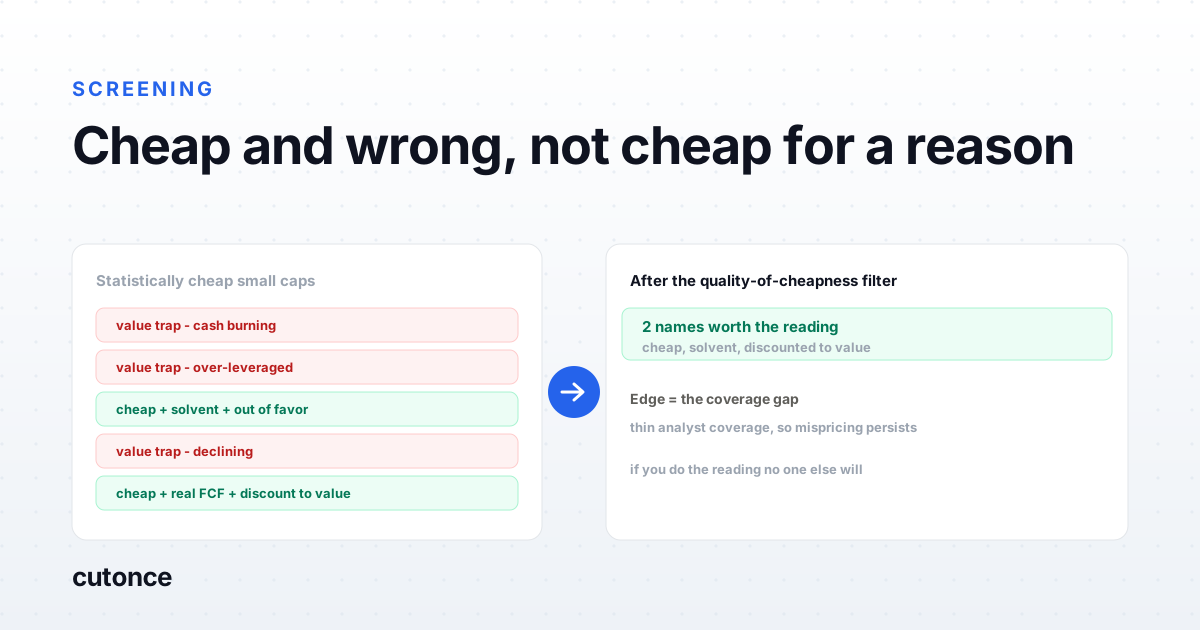
- Small caps are where undervaluation persists, because thin analyst coverage means mispricings do not get arbitraged away quickly. The coverage gap is the edge - if you will do the reading no one else is.
- A low multiple is a starting point, not a thesis. The screen's real job is to separate cheap-for-a-reason (structurally impaired) from cheap-and-wrong (temporarily out of favor), and only the second is an opportunity.
- Deep-value and contrarian screens need a quality-of-cheapness filter: balance-sheet strength, real free cash flow, and no going-concern language, so you are buying a discount rather than a value trap.
- Compare a name to its own intrinsic value and its real peers, not to the market. Cheap relative to fair value with a margin of safety is the signal; cheap relative to the S&P is noise.
Market efficiency is real where a lot of people are looking and thin where they are not. That is why the durable pockets of undervaluation sit in small caps and in the out-of-favor corners of the market - names with little analyst coverage, where a genuine mispricing can persist because almost no one is doing the work to close it. The catch is that most cheap stocks are cheap for a reason, so a deep-value screen that stops at the multiple mostly collects value traps. The skill is in the second filter: separating cheap-and-wrong from cheap-for-a-reason. Here is how to build a screen that does that.
The edge is the coverage gap
A mega-cap is analyzed by hundreds of professionals, so an obvious discount gets arbitraged away almost immediately. A small cap might have one analyst, or none. That absence is the opportunity: a real mispricing can sit there unrecognized for quarters. But the same absence is the cost - nobody has done the reading, so if you want the discount you have to do it yourself. A screen that finds cheap small caps is only half the tool; the other half is reading the filings and calls the crowd skipped, which is exactly where automated document analysis turns a coverage gap from a problem into an edge.
A low multiple is a question, not an answer
Every deep-value screen starts with cheapness - low EV/EBITDA, low price-to-free-cash-flow, a discount to book or to estimated intrinsic value. That is the right starting point and the wrong stopping point. A low multiple is the market telling you it expects something bad; sometimes it is right (the business is impaired) and sometimes it is wrong (the business is fine and out of favor). The screen's actual job is to sort those two. Comparing price to a real estimate of worth is the frame - the intrinsic value entry lays out why price-versus-value beats price-versus-market as a starting signal.
The quality-of-cheapness filter
The filter that turns a value trap generator into a value screen tests whether the cheapness is backed by anything:
| Filter | What it rules out |
|---|---|
| Balance-sheet strength | Over-leveraged names one bad quarter from forced action. |
| Positive, durable free cash flow | Cash-burners whose cheapness is a countdown, not a discount. |
| No distress language | Going-concern or covenant warnings buried in the filings. |
| Stable or improving fundamentals | Structurally declining businesses that stay cheap forever. |
Buying cheapness with these behind it is buying a discount with a margin of safety. Buying cheapness without them is buying a value trap and hoping.
Compare to value and to peers, not to the market
"Cheap versus the S&P" is close to meaningless for a small cap in an unrelated business. The comparisons that matter are two: cheap versus its own estimated intrinsic value (is there a real gap, and how big), and cheap versus its actual industry peers (is the whole group depressed, or is this name an outlier). A contrarian bet is strongest when a name is discounted against both its own worth and its peers for reasons you can read and disagree with. Running an intrinsic value estimate across the whole small-cap universe, rather than one name at a time, is the scalable version of this - the mechanics are in automating a DCF valuation across many tickers.
Running it as a pipeline
In Cutonce this is a saved pipeline: a source node sets the small-cap universe, a filter finds the statistically cheap names, a second filter enforces the quality-of-cheapness tests, and an AI node reads the filings and calls the crowd ignored to flag distress the numbers missed. The output is a ranked shortlist of names that are cheap and backed by something, delivered to a sheet or Slack. It reruns on a schedule, so new discounts surface as prices move and fundamentals update.
What you get is not a list of cheap stocks - anyone can generate that. It is the much shorter list of names that are cheap, solvent, and quietly out of favor, which is the only version of deep value worth your time.
Note: this is not investment advice. Small caps carry liquidity and concentration risks a screen does not capture, and a cheap name that passes every filter can still be cheap for a reason you have not found. Verify each name against its filings and your own analysis before acting on it.
Frequently asked
How do you screen for undervalued small-cap stocks? Start with cheapness relative to fundamentals - low EV/EBITDA, price-to-free-cash-flow, or a discount to estimated intrinsic value - across the small-cap universe. Then apply a quality-of-cheapness filter (solid balance sheet, real free cash flow, no distress language) to strip out the names that are cheap because they are impaired. The edge in small caps comes from thin analyst coverage, so the screen is most useful when you pair it with actually reading the filings the crowd is ignoring.
What is a value trap, and how do you avoid it? A value trap is a stock that looks cheap on the multiples but stays cheap - or gets cheaper - because the business is structurally declining, over-leveraged, or burning cash. You avoid it by not stopping at the multiple: require balance-sheet strength, positive and durable free cash flow, and an absence of going-concern or covenant-distress language in the filings. Cheapness plus quality-of-cheapness is the difference between a discount and a trap.
Why do small caps offer more undervaluation than large caps? Because far fewer analysts cover them. A mega-cap is picked over by hundreds of professionals, so obvious mispricings get closed fast; a small cap may have little or no coverage, so a genuine discount can sit unrecognized for a long time. That inefficiency is the opportunity - but it only pays if you are willing to do the primary-source reading that the lack of coverage leaves undone.
What is a deep-value or contrarian screen? A deep-value screen looks for statistically cheap stocks - very low multiples, discounts to book or intrinsic value - often in names the market has abandoned. A contrarian screen deliberately targets the out-of-favor. Both need a quality filter bolted on, because the cheapest names are cheap for a reason more often than not; the job is to find the minority that are cheap and wrong rather than cheap and right.